Last-Click Attribution Is Lying to You
Last click attribution problems include ignoring large parts of what created a sale. Learn where this attribution model is lying to you.


Last-click attribution is lying to you, and the worst part is that most marketing teams already know it. They see budgets flowing toward the final touchpoint while top-of-funnel channels starve, and they watch brand awareness campaigns get cut because they don't convert.
However, the model stays in place because it's familiar and easy to defend in a quarterly review, as proven by the fact that over 78% of marketers are still using it.
Attribution shapes every budget decision you make, and if you get it wrong, you're rewarding the wrong channels. You’re also punishing the right ones, and optimizing toward a distorted version of reality.
Knowing how to fix these last-click attribution problems starts with understanding why it became the default in the first place. Once you understand why it exists, you can start making the necessary changes to your marketing strategy.
Quick Takeaways
- Last-click attribution tells an incomplete story that ignores most of the customer journey.
- This type of attribution skews your marketing decisions, leading to underinvestment in growth-driving channels.
- No attribution model is perfect, but some are far better than others because they provide a more balanced and realistic view of performance.
- Better measurement leads to better growth, as moving beyond last-click to a more holistic approach helps you better allocate your budget.
What Is Last-Click Attribution?
Last-click attribution is a measurement model that assigns 100% of the conversion credit to the final touchpoint a customer interacted with before purchasing. When a customer clicks a branded search ad and buys the product, that ad receives all the credit for the sale. The problem is that every blog post and display ad that nudged the customer along the journey becomes invisible, so you have no idea of their true value.
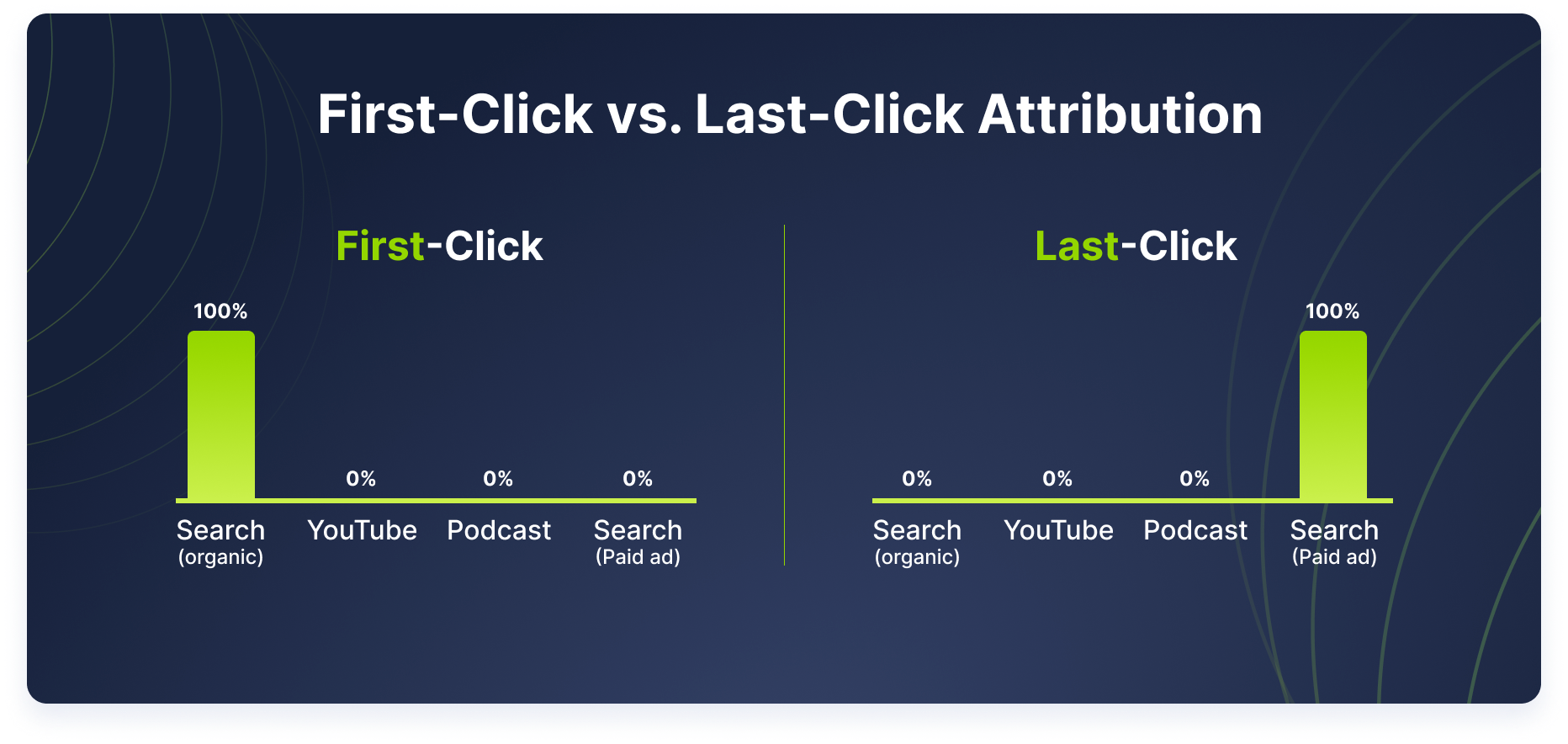
This type of attribution became the default because it's easy. Early analytics platforms made last-click effortless to implement, and marketers gravitated toward a clear, uncomplicated story where simplicity won over accuracy.
The problem is that last-click attribution overvalues brand keywords, which are terms people search when they are already ready to buy, while systematically starving the upper-funnel channels that created that intent in the first place. As explained by Supermetrics, this model rewards closers and ignores openers entirely.
That structural blind spot is a major issue with last-click attribution, and the damage it causes runs deeper than most teams realize.
The Biggest Last-Click Attribution Problems
Last-click attribution actively distorts decision-making in ways that compound over time. Understanding these structural flaws is what separates teams that optimize toward real growth from those chasing a measurement illusion.
The main problem is that last-click attribution ignores every touchpoint that builds awareness and creates intent. A customer who saw three display ads, read a blog post, and then clicked a branded search ad didn't convert because of that final click. That click was the door, but everything else built the house.
When comparing last-click attribution vs multi-touch models, the gap becomes stark. Multi-touch models distribute credit across the full journey, revealing which channels actually influence decisions, not just which one happened to be nearby at checkout. Without that visibility, upper-funnel channels get systematically defunded, and teams wonder why their pipeline quietly dries up months later.
The damage is predictable, but this flawed model is still alive because of a set of persistent myths most marketing teams haven't fully examined.
Common Marketing Attribution Myths That Keep It Alive
Despite well-documented problems, last-click attribution remains stubbornly common because several persistent myths make it feel more reliable than it actually is.
The first myth is that the default way of doing things must be accurate. This assumption is perhaps the most damaging because default doesn't mean correct; it means convenient. Last-click attribution bias gets reinforced every time a team accepts platform defaults without questioning the underlying logic.
A second myth is that companies that rely mostly on paid search don’t need to narrow down attribution. In practice, paid search often captures intent that was built elsewhere through social content or organic discovery. Crediting only the final click is like tipping only the cashier at a restaurant, and could lead to wasted ad spend.
Finally, some believe that multi-touch attribution is too complicated. Yes, it does require more setup, but the cost of a flawed model compounds quietly over time, as earlier touchpoints get defunded and the top of your funnel slowly starves.
These myths share a common thread: they prioritize comfort over accuracy. Breaking free from them is the first step, but it also helps to understand how last-click isn't the only attribution model with blind spots.
Understanding Attribution Model Flaws Across the Board
Last-click attribution gets the most criticism, but it's worth acknowledging that no single attribution model is perfect. Every model carries its own blind spots:
- First-click attribution overcredits awareness channels while ignoring conversion-driving touchpoints.
- Linear attribution spreads credit so evenly that it flattens meaningful distinctions.
- Time-decay models assume recency always equals relevance, which isn't always true.
The real issue isn't just last-click, but assuming any one model captures the full truth of a customer journey.
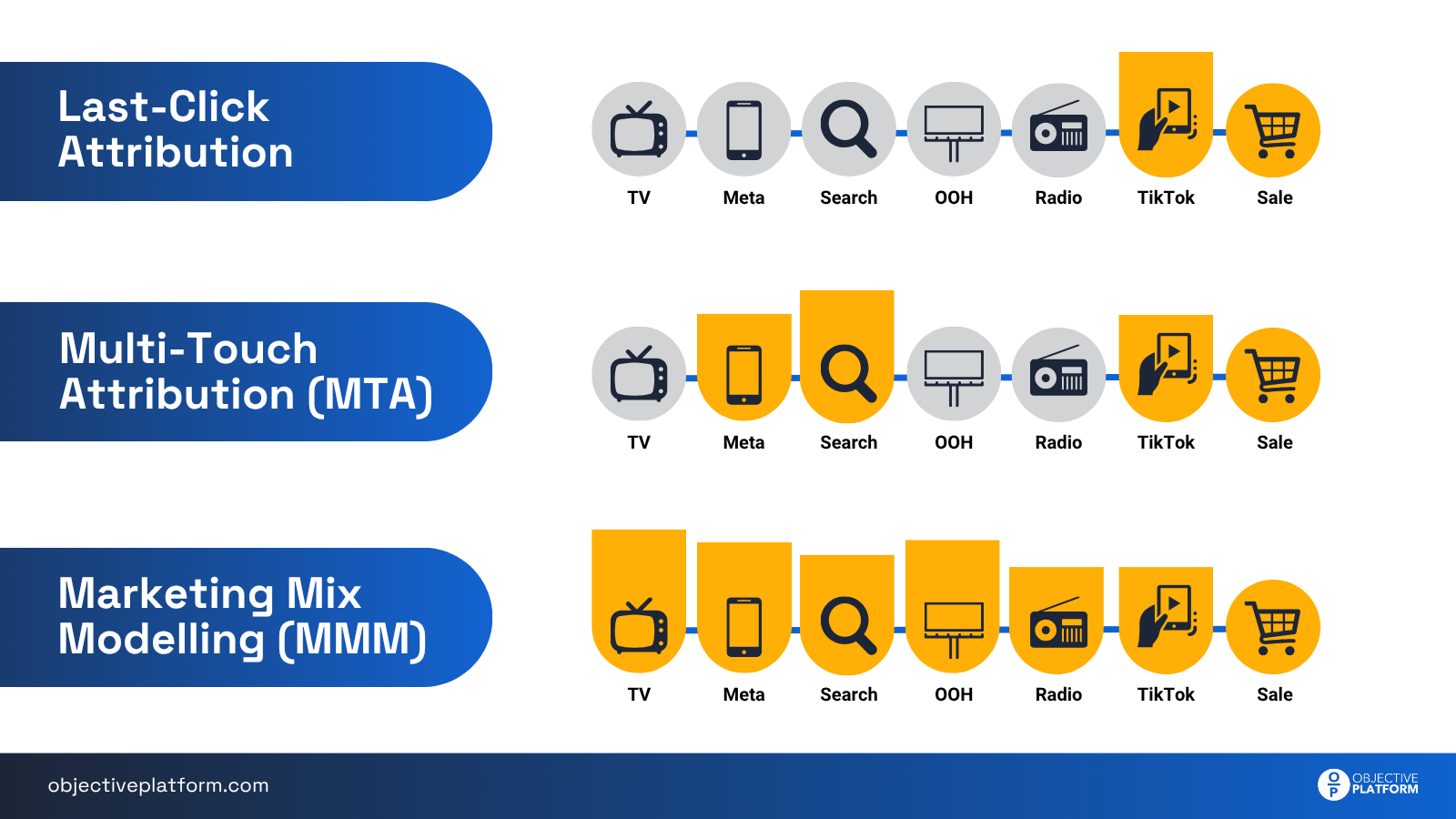
Alternatives to last-click attribution exist on a spectrum, from simple rule-based models to sophisticated data-driven approaches. Understanding where every model falls short is actually the first step toward smarter measurement, and that's precisely where multi-touch attribution starts to change the game.
What Marketers Should Do Instead
The fix isn't complicated, as it starts with choosing a model that reflects how customers actually buy. The time decay attribution model is a strong starting point for most ecommerce teams because it assigns more credit to touchpoints closest to conversion while still acknowledging earlier interactions. That balance makes it far more honest than last-click alone.
Beyond model selection, a few practical shifts make a real difference:
- Audit your current attribution setup before reallocating any budget
- Run model comparison reports to see where credit distribution diverges
- Treat attribution as a living process, not a one-time configuration
No single model is perfect, so the goal is to minimize distortion. The right signal changes everything about how you optimize.
Stop Optimizing for the Wrong Signal
Understanding why last-click attribution is wrong directly determines where your budget goes and which channels survive the next planning cycle. When you reward only the final touchpoint, you starve the campaigns doing the heaviest lifting upstream.
Most marketers know something feels off in their reporting, but few take the next step to fix it. If you’re still relying on last-click attribution, you’re likely undervaluing key channels and missing growth opportunities.
Monkedia helps brands move beyond outdated models with smarter attribution strategies built for today’s complex customer journeys. Contact Monkedia today and start making decisions based on reality, not assumptions.
FAQ: The Problem With Last Click Attribution
What are the main last click attribution problems?
Last-click attribution ignores most of the customer journey and undervalues awareness and consideration efforts. The result is skewed performance data and poor budget decisions.
Are all attribution models flawed?
Yes, every model has limitations because customer journeys are complex and non-linear. However, some models, like multi-touch attribution, provide a more balanced and realistic view than single-touch approaches.
Is multi-touch attribution better for ecommerce?
In most cases, yes. Multi-touch attribution helps ecommerce brands understand how different channels work together, leading to better budget allocation and more effective marketing strategies.
Why do so many companies still use last-click attribution?
It’s simple, widely available in platforms like Google Ads, and easy to understand. However, that simplicity comes at the cost of accuracy.
What’s the best alternative to last-click attribution?
There’s no one-size-fits-all answer, but combining multi-touch attribution with incrementality testing and analytics tools provides a much clearer picture of marketing performance.