Why Most Paid Ads Fail After the First 90 Days
Discover why paid ads stop working after 90 days and how to overcome ad fatigue, creative burnout, and performance decline.

Most paid ad campaigns don’t fail immediately. In fact, many perform well at the start.
Early results often look promising. Click-through rates are strong. Conversions come in steadily. Cost efficiency holds. Then performance starts to drop.
Paid ads stop working the way they used to. Costs increase, engagement declines, and conversions become harder to sustain.
This pattern shows up across industries, especially in ecommerce. It’s often blamed on platform changes or audience saturation. In reality, it usually comes down to a combination of ad fatigue, creative burnout, and a lack of strategic evolution.
In this article, we’ll break down why most paid ads lose momentum after the first 90 days and what teams need to do to maintain performance over time.
Quick Takeaways
- Paid ads stop working when creative, audience targeting, and messaging fail to evolve.
- Ad fatigue is one of the most common causes of declining performance in ecommerce campaigns.
- Creative burnout leads to repetitive messaging that audiences begin to ignore.
- Performance drops often come from internal strategy gaps, not platform limitations.
- Sustained results require ongoing testing, creative refresh cycles, and data-driven adjustments.
The 90-Day Performance Drop: What Actually Happens
Most paid campaigns follow a predictable pattern.
The first few weeks often deliver strong results. Platforms optimize delivery, audiences respond to new creative, and performance metrics trend in the right direction. Cost per acquisition stays efficient, and return on ad spend looks sustainable.
Then the plateau begins.
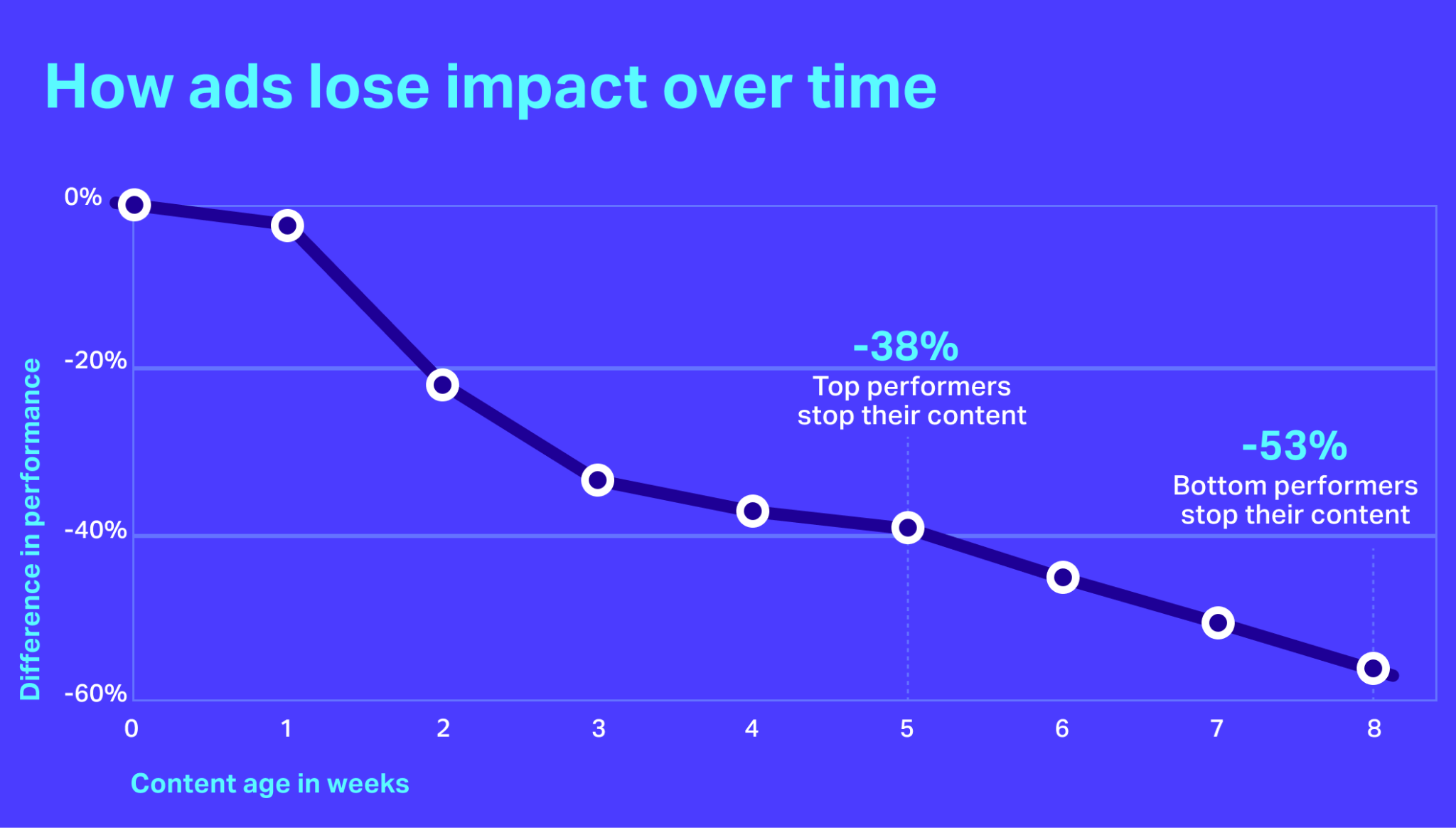
Performance stabilizes for a short period before gradually declining. Click-through rates drop. Conversion rates follow. Costs begin to rise as platforms struggle to find new, high-quality impressions within the same audience pool.
This is the point where many teams assume something external has changed. They look at platform updates, seasonality, or competition. While those factors can play a role, they are rarely the primary cause.
In most cases, the issue is internal.
The campaign has stopped evolving. The same creative continues to run. Messaging remains unchanged. Targeting stays static. What worked in the first 30 to 60 days is expected to carry performance forward indefinitely.
Paid media does not work that way.
Platforms reward freshness. Audiences respond to novelty. Without continuous updates, performance naturally declines. The 90-day mark is not a hard cutoff, but it is often when these underlying issues become visible in the data.
Ad Fatigue in Ecommerce Campaigns
Ad fatigue is one of the most common reasons paid ads stop working.
It occurs when the same audience sees the same creative too many times. Overexposure reduces engagement. What once captured attention becomes easy to ignore.
In ecommerce campaigns, this happens quickly.
Audiences are often limited by targeting constraints such as interests, behaviors, or past site activity. As frequency increases, the same users are served the same ads repeatedly. Even high-performing creative loses effectiveness under these conditions.
The impact shows up clearly in performance metrics:
- Declining click-through rates
- Rising cost per click
- Increasing cost per acquisition
- Lower conversion rates
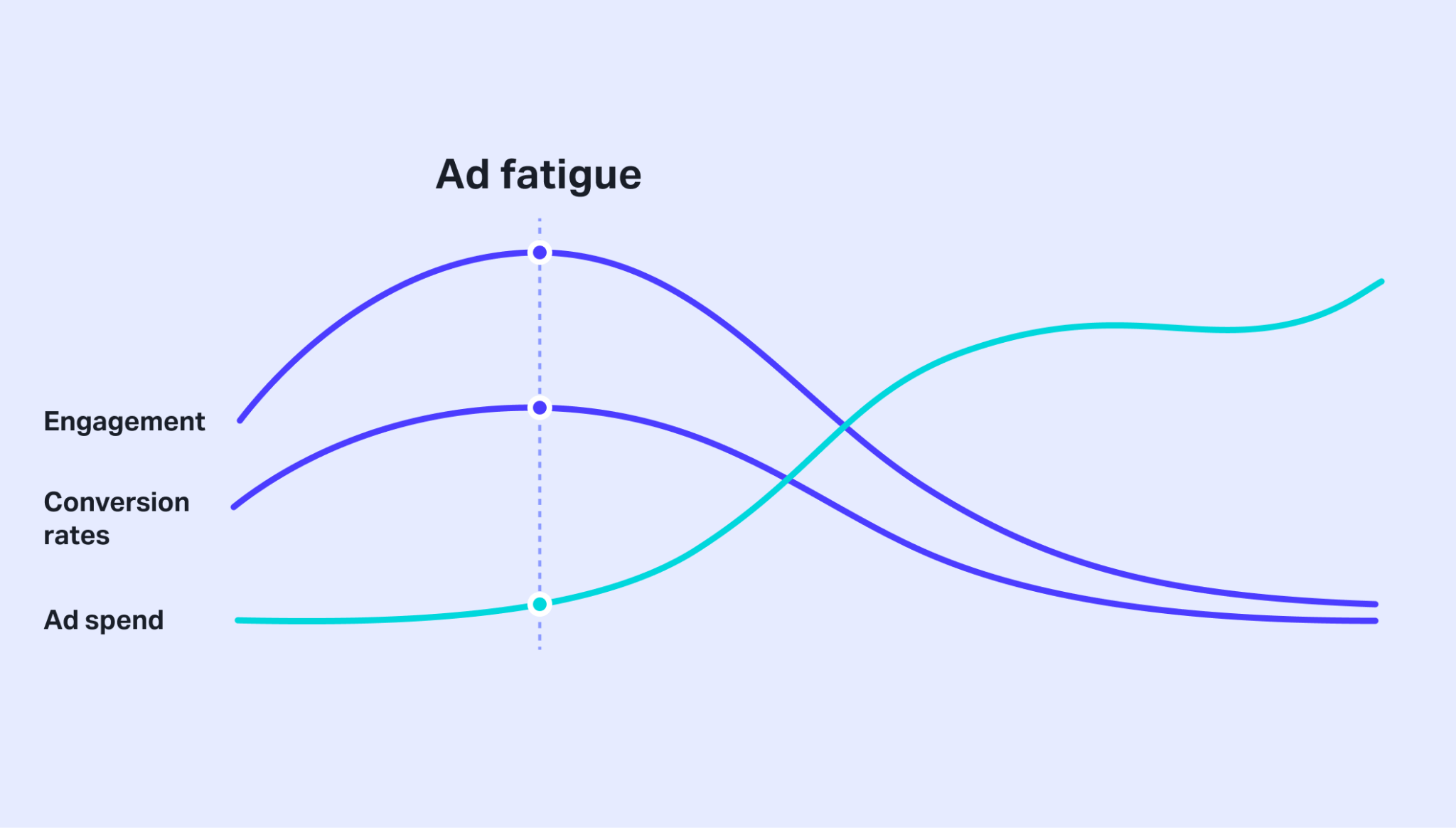
These signals indicate that the audience is no longer responding the way it did initially.
Ad fatigue is not just about repetition. It is about diminishing relevance.
When creative does not change, it stops feeling timely or engaging. Audiences tune it out, even if the offer itself remains strong.
To maintain performance, teams need to recognize that fatigue is inevitable. The goal is not to avoid it entirely, but to manage it through consistent creative refresh cycles and audience strategy adjustments.
Creative Burnout in Paid Ads
Creative burnout happens when teams rely too heavily on a small set of winning assets.
At first, this approach makes sense. A high-performing ad delivers results, so it gets scaled. Budgets increase, reach expands, and the same creative continues to drive performance.
Over time, that same creative becomes the problem.
Audiences see it repeatedly. The message becomes predictable. Visuals lose impact. What once felt compelling starts to blend into everything else in the feed.
This is where many teams get stuck. They continue to optimize around the same creative instead of introducing new variations. Minor tweaks replace meaningful iteration.
Creative burnout is not always obvious at first. Performance declines gradually, which makes it easy to attribute changes to external factors. In reality, the issue often comes down to a lack of creative volume and variation.
Strong paid media programs treat creative as a continuous process, not a one-time asset. That means developing multiple angles, testing new formats, and refreshing messaging before performance drops significantly.
Without that pipeline, campaigns depend too heavily on a limited set of ideas, and results follow the same downward trend.
Audience Saturation and Diminishing Returns
Audience saturation happens when a campaign reaches the limits of its target group.
In the early stages, platforms prioritize high-intent users within the selected audience. These users are more likely to engage and convert, which drives strong initial performance.
As the campaign continues, those users become exhausted.
The platform begins serving ads to lower-intent segments within the same audience. Frequency increases, but engagement decreases. Costs rise because the system has to work harder to generate results.
This creates a cycle of diminishing returns.
Even if the creative remains strong, performance declines because the audience has already been heavily exposed. In ecommerce, where audience pools can be relatively narrow, this effect becomes more pronounced.
Many teams respond by increasing spend or tightening targeting. Both approaches can accelerate the problem rather than solve it.
To maintain performance, audience strategy needs to evolve alongside creative. That includes expanding targeting, introducing new segments, and continuously testing new audience combinations.
Why Most Teams React Too Late
The biggest issue is not ad fatigue or creative burnout on their own. It is how teams respond to them.
Most teams wait until performance drops before making changes.
They rely on early success as a signal that the campaign is stable. As long as results remain within acceptable ranges, there is little urgency to adjust creative, messaging, or targeting.
By the time performance declines significantly, the campaign is already under pressure.
At that point, teams shift into reactive mode. Budgets are adjusted. Creative is swapped out quickly. Targeting changes are made without a clear testing framework.
This approach often leads to inconsistent results.
Instead of building a system that supports ongoing performance, teams attempt to recover lost momentum. The focus shifts from scaling what works to fixing what has already broken.
Sustained performance requires a different mindset.
High-performing teams plan for decline before it happens. They build creative pipelines, schedule refresh cycles, and test new audiences continuously. Performance is treated as something that needs to be maintained, not something that will continue on its own.
How to Extend Paid Ad Performance Beyond 90 Days
Sustaining paid media performance requires a shift from reactive optimization to proactive strategy.
Teams that maintain results over time do not rely on a single winning campaign. They build systems that continuously refresh creative, expand audiences, and adapt messaging based on performance data.
Build a consistent creative pipeline
Creative should never be treated as a one-time deliverable. High-performing teams develop multiple variations at once, including different hooks, formats, and messaging angles.
This allows campaigns to evolve before performance declines. Instead of replacing creative after fatigue sets in, new assets are already in rotation.
Test continuously, not occasionally
Testing should be built into the campaign structure. This includes testing new creatives, audiences, and offers on an ongoing basis.
Rather than making large changes all at once, teams can introduce controlled variations and measure performance over time. This approach creates a steady stream of insights that inform future decisions.
Expand and refine audience strategy
Audience performance naturally declines as saturation increases. To maintain efficiency, teams need to continuously explore new segments.
This may include broader targeting, lookalike audiences, or new behavioral signals. The goal is to reduce reliance on a single audience group and create more opportunities for performance.
Refresh messaging before it loses impact
Messaging tends to follow the same lifecycle as creative. What resonates early on becomes less effective over time.
Teams that maintain performance regularly introduce new angles. This can include shifting the value proposition, highlighting different product benefits, or aligning messaging with seasonal trends.
Use data to guide iteration
Performance data should drive decision-making at every stage. Metrics such as frequency, engagement, and conversion rates provide early signals of fatigue.
By monitoring these indicators closely, teams can make adjustments before performance drops significantly. This keeps campaigns stable and reduces the need for reactive changes.
Sustain Paid Ad Performance Today with Monkedia
Paid media performance depends on more than initial success. Without a strategy for ongoing optimization, even the strongest campaigns lose momentum over time.
Monkedia helps brands scale paid media through a balance of data, creative, and predictive insight. By focusing on sustainable growth and measurable outcomes, Monkedia supports teams looking to expand performance without sacrificing ROAS.